Don't have a paid plan? Join the Developer Program and provision a fully-featured sandbox for free.
Facts
- HTTP
- JavaScript
- Python
- Java
POST https://slack.com/api/admin.conversations.setConversationPrefs

app.client.admin.conversations.setConversationPrefs

app.client.admin_conversations_setConversationPrefs

app.client().adminConversationsSetConversationPrefs
application/x-www-form-urlencoded application/json Arguments
Required arguments
tokenstringRequiredAuthentication token bearing required scopes. Tokens should be passed as an HTTP Authorization header or alternatively, as a POST parameter.
xxxx-xxxxxxxxx-xxxxchannel_idstringRequiredThe channel to set the prefs for
C1234prefsstringRequiredThe prefs for this channel in a stringified JSON format.
{'who_can_post':'type:admin,user:U1234'}Usage info
This Admin API method sets the posting permissions for a channel.
This method allows you to adjust several conversation settings. To set any of these permissions, you'll use the prefs argument with some stringified JSON. Stringified JSON means JSON with white space removed and fields marked by single quotations. Since this argument won't contain more complex characters, you don't need to do further encoding.
You can see or change the users who have permission in your Org’s Channel Management settings dashboard.
Posting permissions
To adjust who's allowed to post in a channel, use the who_can_post field inside your prefs argument:
"prefs": "{'who_can_post':'type:admin,user:U1234'}"
Inside your stringified JSON for who_can_post, you can specify who the permission applies to in a couple different ways:
-
By
type: you can set posting permissions to include alladminusers, or just anyuserin general. Theusertype is only honored whenadminororg_adminis also provided. -
By list of specific users who have the permission:
user:U1234for a single user oruser:U1234,user:U5678for multiple users. If you're specifying specific people, you can select up to 100 per channel. If you exceed that maximum, you may receive thecould_not_set_channel_preferror.
org_admin can only be used if the channel is an Org-Wide Channel, otherwise you may receive the invalid_value error.The can_thread field works exactly the same inside the prefs object, except that it determines who can respond in threads. You can pass both who_can_post and can_thread to the prefs argument in this method at the same time.
Example:
"prefs": "{'who_can_post':'type:admin,user:U1234','can_thread':'type:user'}"
In addition, while you cannot return to the original "empty" state of each of these fields when the channel is first created, you can always reset the channel to allow everyone to post by using the value ra:
"prefs": "{'who_can_post':'type:ra','can_thread':'type:ra'}"
Slack Connect
In Slack Connect channels, the same fields and values are used by the channel owner (home workspace) to control who can post in a given channel, but they have slightly different meanings:
type:rameans that all home and away workspace members and guests can post.type:regularmeans that only home workspace members can post, but away workspace members and home/away workspace guests cannot.type:adminmeans that only home admins can post, but home/away workspace members or guests cannot.type:org_adminmeans that only home org admins can post, but home/away workspace members or guests cannot.
When listing individual users who can post in the channel, you are free to include user IDs of both home and away users.
Huddles
The can_huddle field determines if a huddle can be started in the channel.
For example:
"prefs": "{'can_huddle':'false'}"
Channel mentions
Channel mention restriction prefs enable_at_channel and enable_at_here can be used to place channel, here, and everyone mention restrictions in a channel.
The enable_at_channel field determines if channel mentions can be used in a channel. The enable_at_here field determines if here mentions can be used in a channel. If these channel prefs have never been set before for a channel, then the relevant mention can be used in a channel. We require that both of these prefs remain synced so if you would like to set one of these prefs, you must also update the other pref, and they must be the same value. We do this because the everyone mention restriction in general channels is also controlled by these prefs.
For example:
"prefs": "{'enable_at_channel':'false', 'enable_at_here':'false'}"
This admin scope is obtained through version two of the OAuth V2 flow, but there are a few additional requirements. The app requesting this scope must be installed by an admin or Owner of an Enterprise organization. Also, the app must be installed on the entire org, not on an individual workspace. See below for more details.
If the app is installed by an Org Admin or Owner, ensure the Channel Management settings provide the appropriate permissions. The Org Admin or Owner installing the app must have the Channel Management role, and must also be granted access to Public channels and Private channels within this role. If these criteria aren't met, the Org Admin or Owner will receive a not_allowed error when attempting to install an app.
Admin API endpoints reach across an entire Enterprise organization, not individual workspaces.
For a token to be imbued with Admin scopes, it must be obtained from installing an app on the entire Enterprise org, not just a workspace within the organization.
To configure and install an app supporting Admin API endpoints on your Enterprise organization:
- Create a new Slack app. Your app will need to be able to handle a standard OAuth 2 flow.
- In the app's settings, select OAuth & Permissions from the left navigation. Scroll down to the section titled Scopes and add the
admin.*scope you want. Click the Save Changes button. - In the app's settings, select Manage Distribution from the left navigation. Under the section titled Share Your App with Other Workspaces, make sure all four sections have the green check. Then click the green Activate Public Distribution button.
- Under the Share Your App with Your Workspace section, copy the Sharable URL and paste it into a browser to initiate the OAuth handshake that will install the app on your organization. You must be logged in as an admin or Owner of your Enterprise organization to install the app.
- Check the dropdown in the upper right of the installation screen to make sure you are installing the app on the organization, not an individual workspace within the organization. See the image below for a visual.
- Once your app completes the OAuth flow, you will be granted an OAuth token that can be used for calling Admin API methods for your organization.
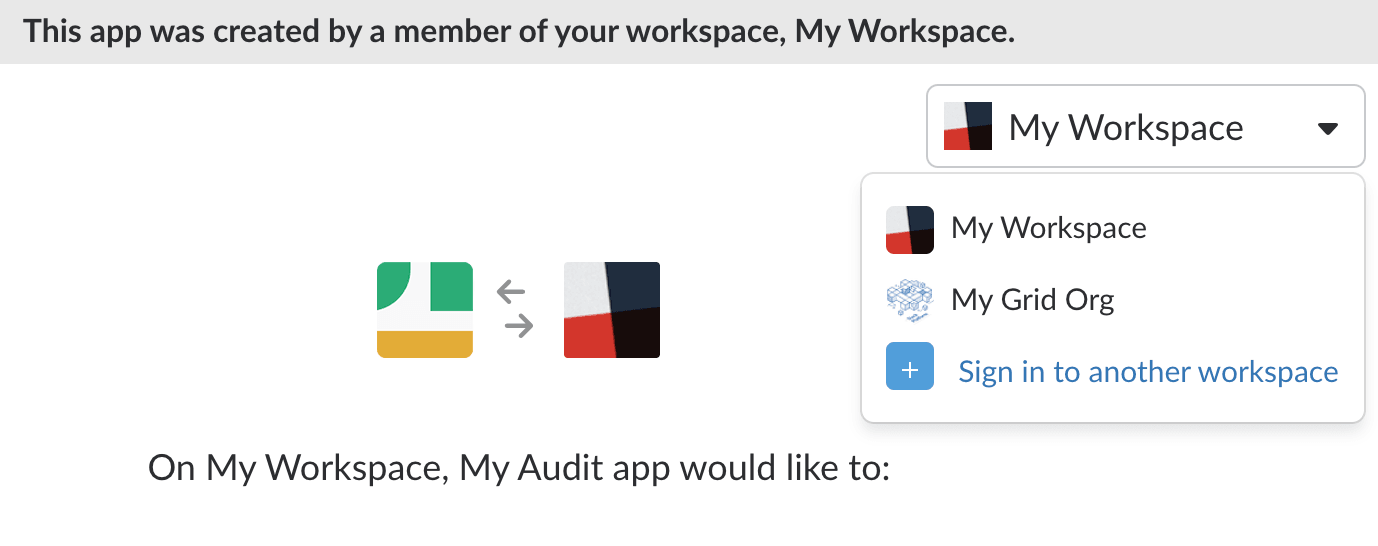
When installing an app to use an Admin API endpoint, be sure to install it on your Enterprise organization, not a workspace within the organization.
Response
Typical success response
{
  "ok": true
}
Errors
This table lists the expected errors that this method could return. However, other errors can be returned in the case where the service is down or other unexpected factors affect processing. Callers should always check the value of the ok parameter in the response.
access_deniedAccess to a resource specified in the request is denied.
accesslimitedAccess to this method is limited on the current network
account_inactiveAuthentication token is for a deleted user or workspace when using a bot token.
channel_mention_sync_requiredIf setting channel mention restriction prefs, both mention prefs must be passed and they must be the same value.
channel_not_foundValue passed for channel was invalid.
channel_type_not_supportedValue given for channel_id was a #general channel.
could_not_set_channel_prefSetting the preference or permission failed.
default_org_wide_channelReturned when you try to modify a default org wide channel.
deprecated_endpointThe endpoint has been deprecated.
ekm_access_deniedAdministrators have suspended the ability to post a message.
enterprise_is_restrictedThe method cannot be called from an Enterprise.
fatal_errorThe server could not complete your operation(s) without encountering a catastrophic error. It's possible some aspect of the operation succeeded before the error was raised.
feature_not_enabledThe Admin APIs feature is not enabled for this team.
internal_errorThe server could not complete your operation(s) without encountering an error, likely due to a transient issue on our end. It's possible some aspect of the operation succeeded before the error was raised.
invalid_arg_nameThe method was passed an argument whose name falls outside the bounds of accepted or expected values. This includes very long names and names with non-alphanumeric characters other than _. If you get this error, it is typically an indication that you have made a very malformed API call.
invalid_argumentsThe method was called with invalid arguments.
invalid_array_argThe method was passed an array as an argument. Please only input valid strings.
invalid_authSome aspect of authentication cannot be validated. Either the provided token is invalid or the request originates from an IP address disallowed from making the request.
invalid_charsetThe method was called via a POST request, but the charset specified in the Content-Type header was invalid. Valid charset names are: utf-8 iso-8859-1.
invalid_form_dataThe method was called via a POST request with Content-Type application/x-www-form-urlencoded or multipart/form-data, but the form data was either missing or syntactically invalid.
invalid_post_typeThe method was called via a POST request, but the specified Content-Type was invalid. Valid types are: application/json application/x-www-form-urlencoded multipart/form-data text/plain.
invalid_valueValue passed for the preferences are invalid
method_deprecatedThe method has been deprecated.
missing_post_typeThe method was called via a POST request and included a data payload, but the request did not include a Content-Type header.
missing_scopeThe calling token is not granted the necessary scopes to complete this operation.
missing_scopeThe token used is not granted the specific scope permissions required to complete this request.
no_permissionThe workspace token used in this request does not have the permissions necessary to complete the request. Make sure your app is a member of the conversation it's attempting to post a message to.
not_allowed_token_typeThe token type used in this request is not allowed.
not_an_adminThe token provided is not associated with an org admin.
not_authedNo authentication token provided.
org_login_requiredThe workspace is undergoing an enterprise migration and will not be available until migration is complete.
ratelimitedThe request has been ratelimited. Refer to the Retry-After header for when to retry the request.
request_timeoutThe method was called via a POST request, but the POST data was either missing or truncated.
restricted_actionA workspace preference prevents the authenticated user from archiving.
service_unavailableThe service is temporarily unavailable
team_access_not_grantedThe token used is not granted the specific workspace access required to complete this request.
team_added_to_orgThe workspace associated with your request is currently undergoing migration to an Enterprise Organization. Web API and other platform operations will be intermittently unavailable until the transition is complete.
token_expiredAuthentication token has expired
token_revokedAuthentication token is for a deleted user or workspace or the app has been removed when using a user token.
two_factor_setup_requiredTwo factor setup is required.